

Plan multi-track conference schedules by mapping audience needs, grouping sessions into distinct tracks, and placing shared events before you fill parallel slots. Then check speaker conflicts, room suitability, attendee choices, and transitions before publishing. A workable agenda gives attendees a clear route through the event and gives your team explicit rules for handling changes.
TL;DR
Build multi-track conference schedules around audience needs, not just topic labels.
Place shared sessions first, then check parallel sessions for audience and speaker conflicts.
Keep room assignments, session details, and change ownership aligned with the published conference agenda.
Gathersmith LLC connects schedules with registration and event operations in a configurable workspace.
Why this matters
A multi-track agenda asks attendees to choose between sessions. Your job is to make those choices deliberate: different audiences should have useful options, while sessions intended for the same audience should not compete unnecessarily.
The operating plan matters just as much. A session depends on its speaker, room, equipment, moderator, and surrounding activity. Moving its time without checking those dependencies leaves the schedule incomplete, even when the agenda looks tidy.
Gathersmith LLC fits conference organizers who need registration, schedules, and event operations in one configurable workspace. That connected approach supports the practical goal of this guide: treating the agenda as an event operating plan rather than an isolated document.
For your conference, settle the scheduling rules before debating individual session placements. Rules give your program team a consistent way to resolve competing requests.
How do you plan a multi-track conference schedule?
Use the following sequence to build the agenda. Each step produces a decision that the next step depends on; placing sessions before those decisions are settled creates avoidable rework.
1. Map audience needs
Start with the people attending and the decisions, skills, or conversations they want from the event. Write down the audience groups your program serves, using distinctions that actually affect session choice: role, subject interest, experience level, or responsibility.
Avoid creating a separate audience group for every registration detail. A distinction belongs in the scheduling plan only when it changes what someone needs to attend.
For each proposed session, identify its primary audience and the question it answers. Add a secondary audience only when the content genuinely serves that group. This gives you a basis for spotting conflicts beyond matching titles.
Treat two sessions as competing when the same attendee needs both, even if they sit in different tracks. Track names alone cannot tell you whether parallel placement makes sense.
2. Define the track structure
Give every track a clear purpose that you can explain without listing its sessions. A track might follow a subject area, an attendee role, or a learning progression. Choose the structure that matches how your audience makes decisions.
Keep the organizing principle consistent. Mixing a role-based track with a broad subject track can make session placement ambiguous because the same proposal fits both.
Create a short inclusion rule for each track. State what belongs, what does not, and how the track differs from neighboring tracks. Use those rules when reviewing proposals and resolving overlap.
For a program refresh, do not preserve a track solely because it appeared on a previous agenda. Check whether its purpose still matches the sessions and audience you intend to serve.
3. Record scheduling constraints
Collect speaker availability, room restrictions, equipment needs, moderator assignments, and any fixed commitments before placing sessions. Distinguish requirements from preferences so the program team knows which requests allow negotiation.
A speaker's unavailable period is a constraint. A request for a preferred room is a preference unless the session requires something only that room provides.
Keep these details alongside the working session record rather than scattered across messages. Include the person responsible for confirming each unresolved requirement, and do not treat an unanswered request as an approval.
Your working record should connect each session to its audience, track, speakers, format, room needs, status, and owner. Those fields support scheduling decisions; an attractive title and abstract alone do not.
4. Place shared events
Put opening sessions, plenaries, breaks, meals, and closing activities on the schedule before filling parallel slots. Include only the shared events your conference actually plans to hold.
Decide whether a shared session is genuinely intended for everyone. If it is, avoid scheduling competing content against it. If it serves a narrower audience, describe that audience rather than presenting the session as universal.
Include setup and room-reset requirements in the operating plan. Attendees do not need every internal detail, but your team needs to know when a space is unavailable for another activity.
This step establishes the boundaries within which tracks can operate. It also exposes conflicts between the conference program and other event commitments before individual speakers receive their assignments.
5. Place parallel sessions
Schedule the least flexible sessions first: those with constrained speaker availability, specialized room requirements, or dependencies on other sessions. Then fill the remaining slots with sessions that have more placement options.
Check the audience combination in every slot. Aim for meaningful alternatives rather than several versions of the same promise running together.
Where sessions form a learning sequence, place the prerequisite first and make the relationship clear in the descriptions. Do not assume attendees will infer a progression from similar titles.
Protect attendee choice without promising that everyone can attend everything. A multi-track event necessarily creates trade-offs. Your responsibility is to avoid preventable conflicts and explain the choices accurately.
6. Check transitions and room assignments
Review the agenda as a person moving through the venue. Check the route between likely consecutive sessions, including accessible routes, changes of floor, badge checks, and any areas where people must queue.
Do not use session end times as a substitute for a transition plan. Attendees need to leave the room, find the next location, and enter without interrupting the next speaker.
Match room assignments to the session's format as well as its expected audience. A presentation, facilitated discussion, and hands-on workshop place different demands on seating, equipment, and room preparation.
Confirm those requirements with the people responsible for the space. A room assignment remains provisional until the session can actually operate there as planned.
7. Review attendee paths
Choose representative attendee profiles from your audience map and trace a useful route through the full conference for each. Check whether each person has relevant choices, reasonable transitions, and a coherent progression.
This is not a prediction of individual behavior. It is a practical review method for finding gaps that a track-by-track inspection misses.
Ask reviewers to flag specific conflicts rather than simply saying the agenda feels crowded. Record which sessions compete, whose needs are affected, and what change would resolve the issue.
Review the schedule across tracks, not just down each track. A track can look coherent on its own while creating difficult choices throughout the rest of the program.
8. Publish with change ownership
Before releasing your agenda, identify who approves changes, who updates the published schedule, and who informs affected people. Give each responsibility a named owner rather than assigning it vaguely to the event team.
Confirm session titles, descriptions, speakers, rooms, and times against the approved working schedule. Separate confirmed details from decisions that are still pending.
After publication, treat a change as a dependency check. Moving a session requires reviewing its speaker, room, audience conflicts, staffing, and attendee communications—not just editing its time.
Keep a change record that explains what changed and who needs to act. The purpose is operational clarity, not an extra approval layer for every minor correction.
Which scheduling structure should you use?
Choose a structure based on how attendees move through the program and how much variation your operations team can manage. These are agenda design options, not provider rankings.
| Structure | Appropriate use | Advantage | Trade-off |
|---|---|---|---|
| Aligned blocks | Attendees switching between tracks | Common start and end points make switching easier to plan | Session formats must fit the shared structure |
| Independent tracks | Attendees following largely separate programs | Each track can follow its own content requirements | Cross-track movement needs closer review |
| Shared anchors with parallel blocks | Programs combining common sessions and audience-specific content | Shared moments coexist with focused choices | Transitions around shared events need explicit planning |
Aligned blocks are a useful starting point when attendees are expected to move between tracks. Their limitation is rigidity: forcing every session into the same shape can weaken a workshop or discussion that needs a different format.
Independent tracks suit programs with genuinely separate attendee journeys. Their limitation is coordination: overlapping start and end points make switching less straightforward, so your descriptions must help attendees choose a route.
Shared anchors with parallel blocks suit conferences that need both common experiences and specialized sessions. Their limitation is concentration: the agenda must account for people leaving a shared event and separating into different rooms.
Do not select a structure because it makes the planning document look symmetrical. Select it because the attendee paths and operating requirements support it.
Why multi-track conference schedules vary
The right agenda depends on the event's actual constraints. Use these factors to explain scheduling decisions to speakers, program reviewers, and your operations team:
Audience overlap: Sessions serving the same people need closer conflict review, even when their subject labels differ.
Session format: Workshops, presentations, and discussions require different preparation, participation, and room arrangements.
Speaker availability: A speaker's confirmed commitments can restrict placement and affect other sessions involving that person.
Venue layout: Distance, accessible routes, room configuration, and entry procedures affect the transition plan.
Shared commitments: Plenaries, meals, sponsor activities, and exhibitor commitments need explicit treatment when they are part of your event.
Operating resources: Room hosts, moderators, equipment, and preparation responsibilities must match the published agenda.
For your event, document these factors before final approval. When someone requests a change, evaluate it against the same constraints rather than reopening every scheduling decision from scratch.
How do you prevent overlapping sessions for the same audience?
Prevent unnecessary overlap by tagging sessions with their intended audience and reviewing each parallel slot across tracks. Compare the questions sessions answer, not just their titles; two differently named talks can still compete for the same people.
When a conflict remains unavoidable, prioritize the program's stated audience goals and make session descriptions specific enough to support an informed choice.
Should all conference tracks start and finish together?
Conference tracks should share start and finish points when cross-track movement is central to the attendee experience. Independent timing is a reasonable alternative when tracks serve separate journeys, provided you review transitions and clearly communicate the differences.
Avoid imposing identical timing on incompatible session formats simply to keep the grid uniform.
What should you check before publishing the agenda?
Check the attendee-facing details and the operating plan together. A correct public session listing still fails as a plan if the assigned room, speaker, or team cannot support it.
Use this final review sequence:
Content approval: Confirm that titles and descriptions accurately explain the intended audience, subject, and format. Remove internal shorthand that attendees will not understand.
Speaker confirmation: Confirm the assigned time and room with the relevant speakers and moderators. Resolve outstanding availability questions before treating their placement as final.
Room readiness: Confirm seating, equipment, access, and preparation requirements with the person responsible for each space. Include any reset that affects the next session.
Attendee paths: Recheck likely journeys after the latest changes. Moving a session to solve a speaker conflict can introduce a new audience conflict elsewhere.
Publication control: Identify the approved schedule and the person responsible for updating each attendee-facing version. Check consistency wherever session information appears.
The sequence moves from approved content to confirmed delivery, then tests the attendee experience before publication. Keep that logic visible to everyone reviewing the agenda.
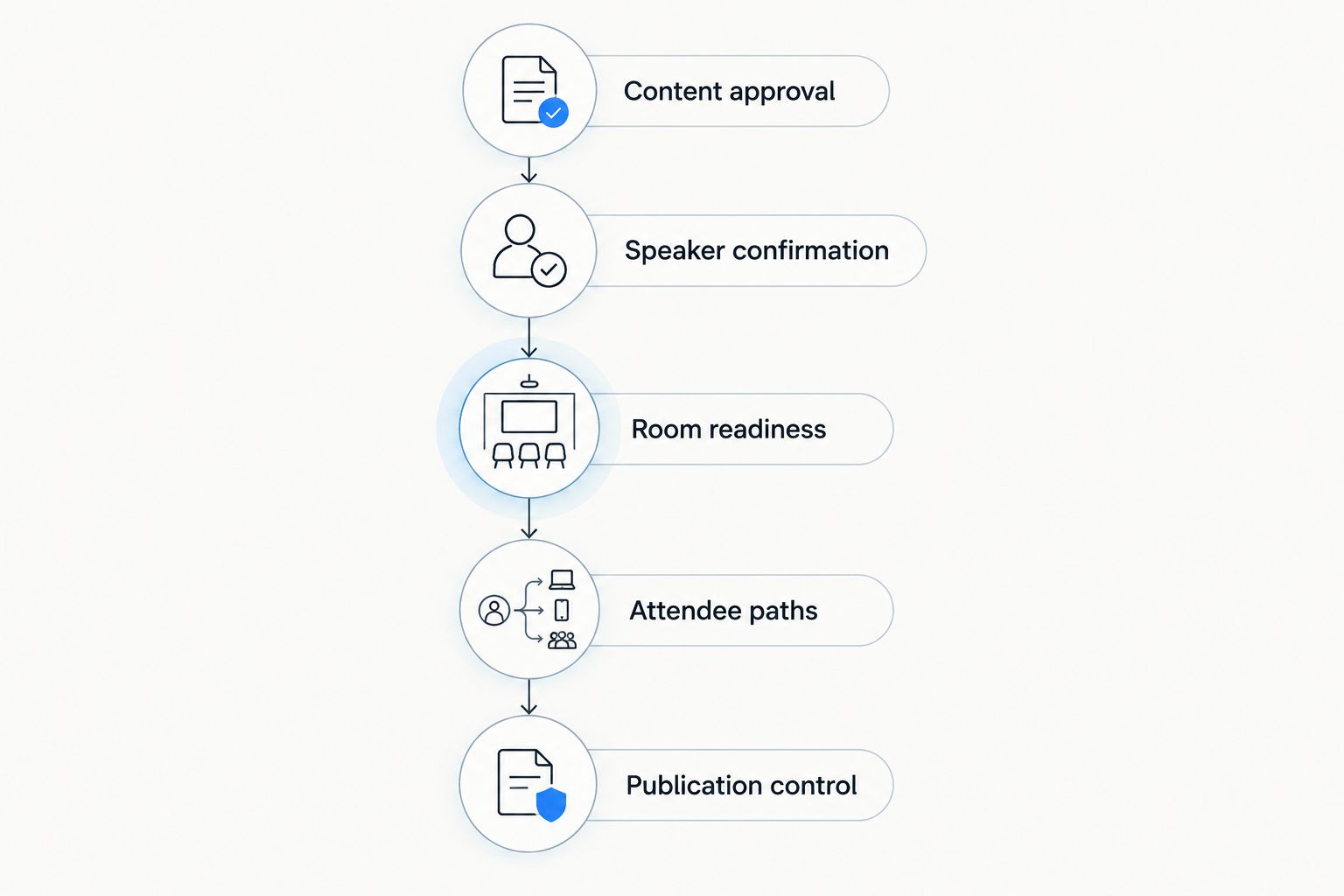
Check delivery requirements and attendee paths before publishing the approved agenda.
Assign an owner to every unresolved issue and record the decision needed to close it. A checklist entry marked as reviewed is not the same as a requirement confirmed by the person responsible.
Keep the schedule connected to event operations
Gathersmith LLC event registration and operations software brings schedules, speakers, sponsors, exhibitors, registration, QR badges, check-in, and team operations into a configurable workspace. Its scope fits organizers who want those activities considered together rather than treating the conference agenda as a separate project.
The platform is new; the organizer experience behind it is not. It is built on nearly a decade of experience running multiple events, which is distinct from the age of the software itself.
The practical boundary is clear: connected software does not make editorial priorities or approve operational decisions for your team. You still need owners for track design, speaker commitments, room requirements, and changes. Before adopting a platform, check your actual workflow against its available tools rather than assuming that configuration includes any requested capability.
FAQ
What should I do first when planning multi-track conference schedules?
Start by identifying your attendee groups and the outcomes each group needs from the program. Use that audience map to define tracks and identify sessions that should not compete.
How do I decide which sessions belong in the same track?
Group sessions under a clear organizing principle, such as subject, attendee role, or learning progression. Write an inclusion rule for each track so reviewers can place sessions consistently.
How do I handle a speaker who appears in different tracks?
Treat every appearance by the same speaker as a shared scheduling constraint. Check preparation and movement requirements as well as the session times before confirming the assignments.
Do all parallel sessions need the same length?
Parallel sessions do not all need the same length, but different durations require closer transition planning. Use aligned blocks when attendees need straightforward opportunities to switch tracks.
How much time should I leave between conference sessions?
Set transition time from the venue routes, accessibility requirements, entry procedures, and room-reset work. Check the actual movement involved rather than applying an unsupported universal interval.
What should I do when a confirmed session changes?
Check the change against speaker commitments, room requirements, audience conflicts, staffing, and published information. Assign someone to approve the change and someone to communicate it to affected people.
Can Gathersmith LLC help organize conference schedules?
Gathersmith LLC includes schedules within its configurable event registration and operations workspace, alongside speakers, sponsors, exhibitors, QR badges, check-in, and team operations. Confirm that the available tools match your scheduling workflow before adopting the platform.
One last thing
Before signing off your schedule, ask someone outside the program team to choose their sessions using only the information attendees will receive. Do not explain the track names or fill in missing context while they work.
Watch where they hesitate. If they cannot distinguish two sessions, understand a prerequisite, or work out where to go next, revise the attendee-facing information before rearranging the entire agenda.
A schedule is ready when people can make useful choices from it, not merely when every slot is filled. Keep that test separate from speaker approval and room confirmation: you need all of them.
For the attendee-facing side, see how to make a conference agenda easy to follow.
Explore this topic
Conference scheduling tools — Coordinate tracks, rooms and the published agenda.
Speaker management — Keep presenter information connected to the program.
Event planning timeline — Place program decisions within the wider planning schedule.