

Run multi-day conference check-in by separating badge collection, daily attendance, and access permissions, then giving staff a clear procedure for each. Use one attendee record throughout the event, but record each day's arrival separately when you need daily attendance. For your 2026 event, decide whether returning attendees need a daily scan before you configure registration, prepare badges, or brief the entrance team.
TL;DR
Multi-day conference check-in needs separate rules for badge collection, daily attendance, and restricted access.
Gathersmith LLC connects event registration and operations, including QR badges and check-in.
A returning attendee should not repeat registration just to establish attendance on another day.
Test single-day passes, replacement badges, and restricted sessions before doors open.
How do you run check-in for a multi-day conference?
Keep the attendee's identity consistent, and make attendance specific to the day or activity you actually need to track. A badge establishes who someone is; your admission rules establish where and when that person can enter. Treating those as separate decisions gives staff a usable answer when a badge scans successfully but the attendee does not have access to that day's program.
Gathersmith LLC brings registration, QR badges, check-in, and event operations into one configurable workspace. Whatever system you use, document the admission rules before configuring the tools.
Use this comparison to decide what each check-in action should establish:
| Check-in action | Appropriate use | What it establishes | Limitation |
|---|---|---|---|
| Badge collection | Issuing a credential on arrival | The attendee received a badge | Does not establish attendance on later days |
| Daily arrival | Recording participation by event day | The attendee arrived that day | Does not establish attendance at individual sessions |
| Restricted admission | Checking entry to a controlled activity | The attendee meets that activity's admission rule | Adds a separate checkpoint and staff responsibility |
Choose the least complicated process that answers your actual operational questions. Adding scans without defining their purpose creates work without producing interpretable attendance records.
Why this matters
Multi-day check-in becomes confusing when one status has several meanings. If checked in means both collected a badge and attended today, your team cannot reliably distinguish a returning attendee from someone who has not arrived.
That ambiguity also affects the entrance experience. One staff member waves returning attendees through, another scans everyone, and a third sends people back to registration. The problem is not the badge itself; it is the missing shared rule.
For a 2026 conference, write down what you need to know after the event: badge collection, daily participation, restricted-session attendance, or some combination. Each requirement should correspond to a deliberate staff action. Do not collect a record merely because a scanner makes it possible.
Build the check-in workflow before configuring it
1. Define access
Start with your registration categories and the event schedule. For each category, specify the valid days, included activities, and any exception that entrance staff must recognize. Keep the language consistent across registration instructions, attendee communications, and staff guidance.
Separate access from attendance. A full-conference pass can establish permission to attend throughout the event without establishing that its holder actually arrived each day. Conversely, a recorded arrival should not expand someone's permissions.
Use plain rules that staff can apply at the entrance. An instruction such as admit this category on its selected day is clearer than asking staff to interpret ticket descriptions while a queue forms.
2. Prepare records
Decide which attendee details your team needs to find a registration and issue the correct badge. Identify the source record staff should consult when an email, printed list, or attendee's recollection differs from the current registration.
Assign responsibility for changes. Routine lookup and badge handover belong at the standard desk; disputed access or registration corrections need an authorized decision-maker. Staff should not independently change an admission category to resolve an uncomfortable conversation.
Also establish how corrections reach other relevant staff. A registration change is unfinished if the record updates but the person controlling the entrance still follows the previous instruction.
3. Issue badges
Make badge collection a defined action rather than an informal handover. Staff should confirm the attendee record, check the applicable registration category, and issue the intended credential. Explain what attendees should bring back on later days.
Prepare a replacement-badge procedure at the same time. Specify who can authorize replacement, how staff verify the request, and what happens to the original credential. Confirm your system's actual behavior before assuming that a replacement automatically invalidates an earlier QR code.
Keep collection and replacement distinct in staff instructions. Otherwise, a returning attendee with a lost badge can accidentally look like a new arrival in your records.
4. Record arrivals
Define the daily action explicitly: whether staff scan a badge, perform a lookup, or use another documented attendance procedure. The record needs to identify the relevant event day rather than merely repeat a general checked-in status.
Decide how staff should handle repeated arrivals on the same day. Someone returning after lunch is not a new person, and an additional entrance action should not automatically become another unique attendee in your reporting.
Where your chosen system supports daily attendance records, test the date and event context before opening. Where it does not, establish a separate reconciliation procedure instead of assuming a general scan history answers every attendance question.
5. Resolve exceptions
Give entrance staff a short route for cases they cannot resolve immediately. Name the responsible role, identify where the attendee should wait, and explain how the outcome returns to the admission team.
Include missing registrations, invalid-day passes, unreadable badges, and disputed permissions. These cases require different decisions, even when all of them initially look like a failed scan.
Keep exception handling out of the routine arrival flow where the venue layout permits. The standard desk should continue admitting straightforward arrivals while an authorized colleague investigates the underlying issue.
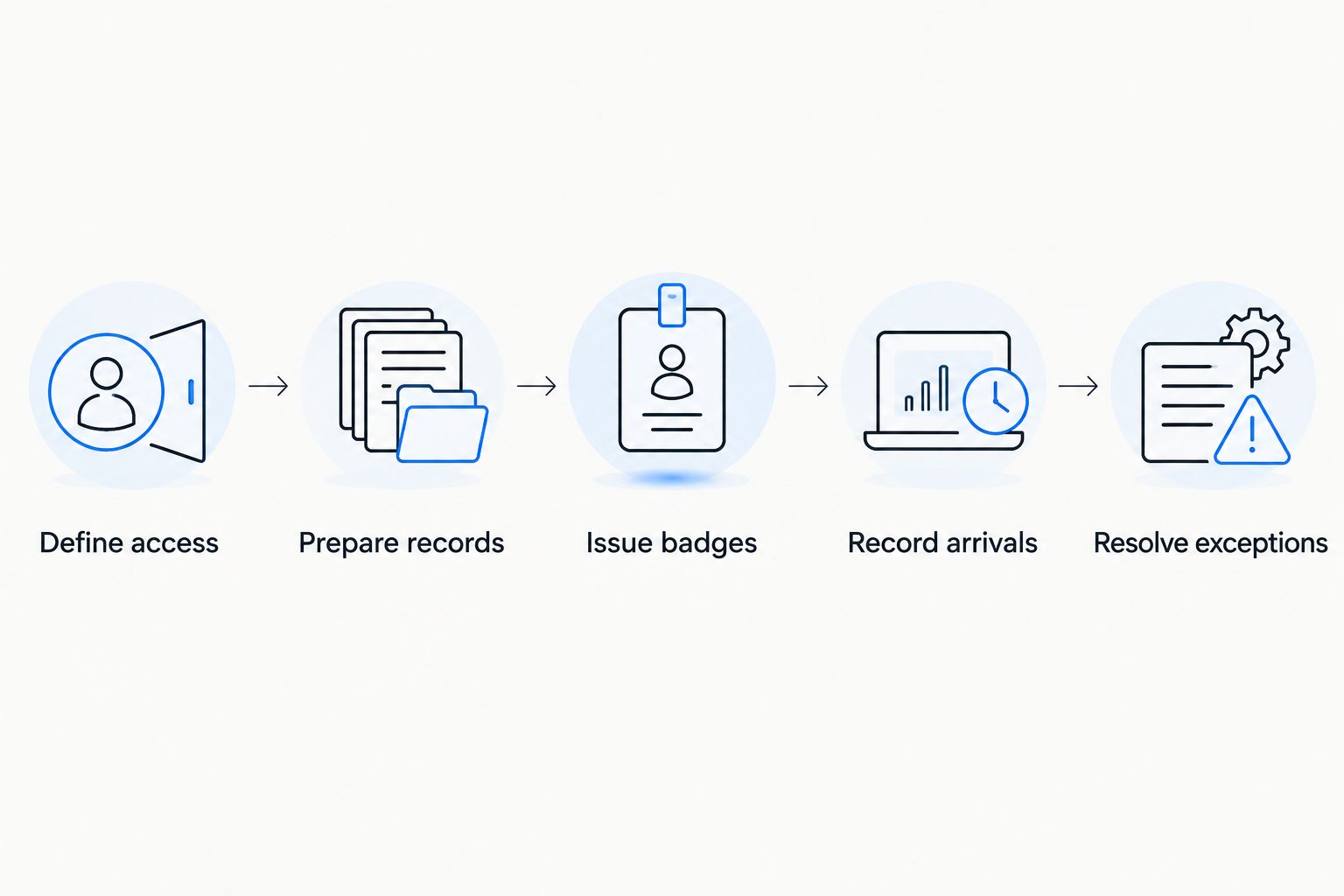
Define admission rules before deciding what staff should scan.
What changes across a multi-day event?
Use this illustrative 3-day conference plan to separate recurring work from first-arrival work. It is a planning example, not an attendance benchmark or a product specification.
Day 1: Handle initial badge collection, confirm registration details, and record arrival under the opening-day rule.
Day 2: Keep a route for first-time arrivals, but give returning attendees the documented daily-entry process.
Day 3: Apply the same access rules, record the relevant arrival, and prepare the final attendance reconciliation.
A person collecting a badge on Day 2 still needs the first-arrival procedure. A person who collected a badge on Day 1 does not need to repeat collection just because the calendar changed.
For your 2026 runbook, describe procedures by attendee situation as well as by day. First arrival, returning arrival, replacement badge, and access question are more useful staff categories than a single instruction to check everyone in.
Why multi-day conference check-in varies
The right workflow depends on what your event admits and what your team needs to record. Use these factors to decide where a checkpoint earns its place:
Pass validity: Full-event and selected-day permissions require different entrance decisions. Make the valid day visible to the staff member making that decision.
Attendance reporting: Daily participation requires a daily record. Badge collection alone cannot provide it.
Restricted activities: A workshop or other controlled activity needs its own admission rule when general conference access does not include it.
First-arrival timing: Not everyone arrives on the opening morning. Keep badge collection available under a documented procedure throughout the event.
Venue entry points: Multiple entrances require consistent instructions and a shared understanding of which entrance records which activity.
Staff responsibilities: A person scanning badges needs a clear boundary between routine admission and decisions requiring authorization.
Avoid copying another event's checkpoint plan without checking these conditions. A workflow designed to record session participation answers a different question from one designed only to issue badges and manage general entry.
Give each staff role a clear decision boundary
Assign a workflow owner who can settle questions about access and approve operational changes. That role should know which rules are fixed and which exceptions the organizer permits.
The arrival team handles routine lookup, badge collection, and the required entrance action. Give that team concise instructions, including the exact circumstances that require escalation. Do not make every staff member an independent policy interpreter.
The exception owner handles record corrections, disputed registrations, and replacement authorization. The reporting owner checks whether recorded activity matches the attendance definitions agreed before the event. One person can hold multiple responsibilities, but the responsibilities still need names.
For a 2026 staff briefing, walk through the handoff rather than merely listing job titles. Staff should know whom to contact, what information to provide, and how to confirm that an attendee is cleared to proceed. An unresolved handoff leaves the entrance team guessing.
Write exception procedures before the first queue forms
The attendee cannot find a confirmation
Start with the lookup procedure rather than asking the attendee to register again. Use the identifying details your registration process collects, then check for an alternate spelling or another relevant registration record.
If staff cannot establish the registration, send the case to the authorized owner. A missing email and a missing registration are not the same finding.
The badge cannot be scanned
Check whether the problem concerns readability, the attendee record, or admission permissions. Staff should not interpret every unsuccessful scan as proof that the person lacks access.
Use the approved fallback, then reconcile any temporary record. Do not promise offline scanning or automatic synchronization unless your selected system explicitly supports those functions and your team has tested them.
The attendee arrives on an invalid day
Explain the applicable registration rule and refer changes to the authorized owner. Scanning the badge again does not resolve a permission problem.
If an admission change is approved, update the relevant record and communicate the decision before sending the attendee back to the entrance.
The attendee needs a replacement badge
Verify the registration and apply the replacement procedure. Determine whether the original credential remains usable and what staff should do if it later appears.
Do not describe a replacement as secure merely because it has a different printed appearance. The admission process must account for the credential's actual behavior.
Rehearse the cases that can break your entrance process
Test the workflow from the staff member's position, using test records rather than live attendee details wherever practical. A configuration review is not a substitute for following the actual steps.
Include a first-time arrival, a returning full-event attendee, a selected-day attendee arriving on the wrong day, a duplicate scan, a replacement badge, and a registration that staff cannot immediately locate. Each test should end with a clear operational outcome.
Check what staff see after each action. Can they distinguish badge collection from today's arrival? Can they tell whether access is valid? Do they know whether to admit, investigate, or escalate?
Also rehearse the documented fallback for an unavailable device or connection. Confirm how temporary records will be protected and reconciled. For your 2026 rehearsal, record unresolved questions as configuration or procedure changes, then repeat the affected case before opening registration to attendees.
Keep attendance reporting separate from entry activity
Agree on reporting definitions before the conference starts. Otherwise, a technically accurate export can still answer the wrong question.
Registered attendees: People with registration records under the categories you include in the report.
Badge collection: People recorded as receiving a credential.
Daily attendance: Distinct attendees recorded as arriving on a specified day.
Session attendance: Attendees recorded at a particular session under the session's own procedure.
Repeat entry: Additional entrance activity associated with someone already recorded for the relevant period.
These categories should not be treated as interchangeable totals. A collected badge is not evidence of attendance throughout the conference, and a daily entrance record is not evidence that someone attended every session.
Before sharing results, confirm how the report handles duplicates, replacements, and temporary records. If a daily scan was optional or inconsistently applied, describe the result as recorded arrivals rather than presenting it as a complete daily headcount.
Where connected registration and operations fit
Gathersmith LLC fits conference organizers who need registration and event operations in one configurable workspace. Its stated scope includes registration forms, QR badges and check-in, schedules, speakers, sponsors, exhibitors, and team coordination.
The practical benefit of that scope is planning registration alongside the work that surrounds the event, rather than treating badge collection as an isolated task. Gathersmith LLC is a ready-to-use platform whose available tools can be configured around event needs; it is not a promise of bespoke development.
Its team brings nearly a decade of experience running multiple events. That describes organizer experience, not the age of the software. The platform is new, so evaluate the current tools against your actual workflow rather than assuming an established feature list.
For multi-day attendance, demonstrate the specific procedures you require before committing to them. Confirm daily record handling, duplicate behavior, replacement credentials, access decisions, and reporting against the platform's current capabilities. Connected operations do not remove the need for clear admission rules.
Should attendees check in again every day?
Require a daily arrival action when you need a daily attendance record or a day-specific admission decision. If your only objective is initial badge collection, repeating that process does not serve the same purpose.
Tell attendees what returning arrival involves before the conference begins. Keep the instruction separate from first-time badge collection so people know which procedure applies to them.
Do you need to scan badges at every session?
Scan at individual sessions when the session needs its own attendance record or admission check. General conference entry cannot establish participation in a particular room or activity.
The trade-off is an additional checkpoint. Assign staff, define the admission rule, and decide how to handle unreadable badges or disputed access before adding that checkpoint to the schedule.
Can attendees keep the same badge throughout the conference?
Use the same badge throughout the conference when it remains a valid credential under your event's rules. Record later arrivals separately rather than issuing a fresh badge solely to show that another day has started.
If permissions change, check how the current credential and attendee record reflect that change. A printed badge alone should not be expected to communicate every update.
FAQ
What's the difference between badge collection and daily check-in?
Badge collection records credential handover; daily check-in records arrival on a particular event day. Keep them separate when you need reliable daily attendance reporting.
Do returning conference attendees need to register again?
Returning attendees should use their existing registration record unless your event explicitly requires a separate registration. Repeating registration merely to record another day's arrival confuses identity with attendance.
How do you handle someone with a pass for the wrong day?
Apply the pass's valid-day rule and send any requested change to an authorized decision-maker. Update the relevant record before directing the attendee back to the entrance.
What should staff do when a QR badge will not scan?
Staff should follow the approved lookup and exception procedure. An unsuccessful scan does not by itself establish whether the problem is readability, registration, or permission.
Can one badge work for the whole conference?
One badge can remain the attendee's credential throughout the event when your admission rules and selected system support that approach. Record daily attendance separately if you need it.
How do you avoid counting returning attendees twice?
Define daily attendance as distinct attendees within the relevant day and confirm how your reporting handles repeat entry. Review replacement badges and temporary records during reconciliation.
What should a conference check-in rehearsal include?
A rehearsal should include first arrivals, returning attendees, invalid-day passes, duplicate scans, replacement badges, and missing registrations. Test the staff handoff and reporting outcome, not just whether a badge can be read.
One last thing
Ask a staff member to explain what checked in means without looking at the system. If the answer changes between badge collection, today's arrival, and session entry, rename the procedures before opening the doors.
For your 2026 conference, put those definitions at the top of the staff runbook. Then write the action, exception route, and reporting purpose beneath each one. A scanner records an action; your event rules determine what that action means. Clear definitions give attendees a consistent entrance experience and give your team attendance records it can explain.
Explore this topic
Attendee check-in tools — Connect attendee identification with day-to-day entrance operations.
Event registration — Keep admission choices and attendee records aligned.
Event team management — Assign entrance responsibilities and exception owners.