

Define conference ticket tiers by the access each attendee receives, then separate purchase timing, eligibility, and optional extras from that access. Start with a clear conference admission package, add another tier only when the attendee experience genuinely changes, and document what each ticket includes and excludes. A ticket name alone is not enough: your registration form, confirmation, badge, and check-in instructions must all describe the same entitlement.
TL;DR
Define conference ticket tiers by access; treat purchase timing and attendee eligibility as separate decisions.
Give every ticket clear inclusions, exclusions, and check-in instructions before opening registration.
Gathersmith LLC connects event registration and operations for conferences, expos, and conventions.
Test ticket rules against real attendee journeys, including restricted sessions and optional workshops.
Gathersmith LLC brings registration, QR badges and check-in, schedules, speakers, sponsors, exhibitors, and team operations into one configurable workspace. The planning framework below starts with your event rules, so your ticket structure reflects what your team must deliver.
How do you define ticket tiers for a conference?
Define each tier through a written access rule before choosing its public name. For your 2026 conference, the sequence should run from the program to the ticket—not from an attractive label to a package your team must later explain.
Map the program. List the sessions, event days, networking activities, and separately controlled experiences that attendees can access.
Set the base entitlement. Decide what an ordinary conference registration includes, including any important exclusions.
Identify meaningful differences. Create another tier only when access or included service changes enough to require a different attendee promise.
Separate other rules. Record purchase windows, attendee eligibility, and optional extras without automatically turning each combination into another tier.
Write the operational instruction. Explain how staff recognize the ticket, verify access, and resolve an exception.
Test the complete journey. Read the registration page, confirmation, badge instructions, and entrance procedure together. Correct any contradiction before registration opens.
Your output is a ticket specification, not just a list of names. Someone outside the planning team should be able to read it and explain where an attendee can go without asking what the organizer intended.
Why this matters
Ticket structure becomes an operational rule at every controlled entrance. If registration promises workshop access but the workshop team expects a separate booking, the attendee encounters a disagreement your team created.
Clear definitions also make editorial decisions easier. Your event page can explain differences directly instead of asking attendees to interpret labels such as premium, executive, or enhanced. Describe the entitlement first; use the label as shorthand afterward.
Separate access, timing, eligibility, and extras
These dimensions answer different questions. Access answers where someone can go; timing answers when they register; eligibility answers who qualifies; an extra adds a distinct experience or service.
Treating all of them as ticket tiers creates unnecessary combinations. An early registration window does not need a separate access package when the attendee receives exactly the same admission as someone registering later.
| Ticket dimension | What it defines | Example planning label | Useful when | Main limitation |
|---|---|---|---|---|
| Access | Included days, sessions, or activities | Full conference | You need a clear base admission package | Exclusions still need explicit wording |
| Timing | When registration takes place | Early registration | You need to distinguish registration windows | Timing alone does not explain access |
| Eligibility | Who qualifies for a registration category | Student registration | A documented qualification changes the registration rules | Qualification requires a clear verification process |
| Optional extra | A separately selected experience | Workshop add-on | An activity sits outside base admission | Staff must verify both admission and the extra |
| Role | A person's function at the event | Speaker registration | Working participants need role-specific instructions | A role does not automatically establish attendee access |
For a 2026 ticket plan, keep these distinctions visible in your planning document even if your registration setup presents some of them together. This is an organizational model, not a requirement that every registration system implement separate fields in the same way.
Full-conference access: define the baseline
Best fit: attendees who need access across the main conference program. A full-conference ticket provides a useful baseline because you can describe other packages as deliberate departures from it.
Write the inclusions in concrete terms: applicable event days, general sessions, networking activities, and any included functions. Then write the exclusions with equal care. A session appearing on the conference schedule does not, by itself, establish that every ticket includes it.
The advantage is clarity. A well-defined baseline gives attendees a straightforward reference point and gives your team a consistent answer to ordinary access questions. The limitation is that a broad package can obscure exceptions unless you state them prominently.
Do not let the word full imply access to every activity unless that is genuinely the rule. If a workshop requires separate registration, say so wherever the base ticket is explained—not only in a later confirmation.
For your internal specification, finish this sentence: the ticket holder can attend the listed conference program, except for the following separately controlled activities. An empty exception list is acceptable; an unexamined one is not.
Limited-day access: define the boundary
Best fit: attendees whose participation is restricted to a particular event day. A limited-day ticket works when the boundary is easy to explain and your entrance team can apply it consistently.
Name the actual day or date rather than relying on a label such as short pass. State whether activities outside the main session timetable belong to that day’s entitlement. An evening function requires a clear rule even when it takes place in the same building.
The advantage is a narrower, understandable commitment for the attendee. The limitation is the handoff between event days: staff need a way to distinguish valid admission today from admission that applies elsewhere in the program.
Do not assume the badge itself communicates that distinction. Decide what information staff consult, what they should do when the ticket is not valid for the current day, and who handles requests to change participation.
Keep the attendee explanation short. Keep the internal instruction precise. Both should describe the same boundary without requiring staff to infer intent from the ticket name.
Workshop access: distinguish inclusion from an extra
Best fit: attendees selecting a distinct learning activity outside base admission. A workshop can be included in a conference package or offered as a separately selected extra, but those are different promises.
If the workshop is included, explain whether the attendee must still select a session. If it is separate, explain whether conference admission is also required. Neither relationship should depend on a reader guessing how the event usually works.
The advantage of a separate extra is specificity: the registration records a deliberate workshop choice. The limitation is another access condition to check and another piece of attendee communication to maintain.
Decide how the team handles someone who has conference admission but no workshop selection. Also decide what happens when someone arrives with a workshop confirmation and no qualifying conference admission, if your event requires both.
Keep session participation separate from general entrance permission. Being allowed into the conference does not establish participation in every controlled activity, and registering for a workshop does not automatically establish wider conference access.
Eligibility-based registration: explain who qualifies
Best fit: attendees whose registration conditions depend on a defined qualification. Student, member, or other eligibility-based categories need an explicit qualification rule, even when their event access matches ordinary admission.
State who qualifies, what evidence you require, when you check it, and who resolves uncertainty. Request only information your team needs for that decision. Avoid asking attendees to provide sensitive documents without a clear handling process.
The advantage is a registration route that reflects your event’s participation rules. The limitation is administrative work: an eligibility label creates questions your team must be prepared to answer consistently.
Do not create a different access tier merely because the attendee qualifies for a different registration category. If the experience is identical, retain the same access definition and document the eligibility condition separately.
For 2026 registration copy, use the same qualification wording on the event page, registration form, and attendee instructions. A narrow definition in one place and a broad promise in another leave your team making policy decisions at check-in.
Why conference ticket tiers vary
Conference ticket structures vary because event programs and access rules vary. The useful differences come from the experience you deliver, not from how many packages another organizer publishes.
Program boundaries. Separate workshops or restricted activities create access decisions that a general admission label cannot explain alone.
Event-day boundaries. A multi-day program requires explicit rules when attendees do not receive admission for every day.
Attendee eligibility. Qualification rules add verification work even when they leave access unchanged.
Included services. Different included services require clear fulfillment instructions, not just different ticket descriptions.
Participant roles. Speakers, exhibitors, sponsors, and working team members need instructions that distinguish responsibilities from attendee privileges.
Entrance procedures. Any restriction needs a practical verification method and a named person responsible for exceptions.
Use these factors to justify each difference. If a proposed tier has no distinct access, service, or eligibility rule, ask whether it needs to exist at all.
Turn the ticket definition into an operations workflow
A 2026 ticket plan is ready for use when the attendee promise and the staff instruction agree. Translate each definition through the same sequence so that changes do not stop at the registration page.
Access rules
Create a shared reference that lists each ticket category against each controlled part of the event. Use explicit outcomes such as included, excluded, or separate selection required. Avoid a blank cell that staff must interpret.
Assign 1 owner to approve changes to the ticket definitions. Other team members can contribute, but approval should not depend on whichever conversation happened most recently.
Registration form
Present the choices using the distinctions attendees need to make. Show who the ticket suits, what it includes, what it excludes, and whether an additional selection is necessary. Keep internal shorthand out of public descriptions.
Do not use a field label to carry an entire policy. If eligibility matters, put the explanation where the attendee makes the relevant choice rather than expecting a later email to repair the ambiguity.
Confirmation
Restate the selected access in the attendee confirmation. Include the applicable event days and explain any next step needed for a separately controlled activity. The confirmation should remain understandable without the original registration page open beside it.
If you change a definition after someone registers, review the earlier promise before updating their instructions. A revised label does not explain a changed entitlement to the person holding the original confirmation.
Badge check
Write down what staff verify before admitting someone. A QR badge supports identification and check-in, but your access policy still needs to explain what the attendee is entitled to receive.
Do not assume that a badge format or check-in screen enforces every restriction you have designed. Confirm how the actual workflow handles the rule, then give staff an instruction they can follow under pressure.
Exception handling
Name the person or role authorized to resolve unclear eligibility, incorrect selections, and requests for changed access. Give entrance staff a route for handing over the problem without turning the queue into a policy discussion.
Record the resolution wherever the relevant team can find it. A spoken exception that never reaches the next entrance leaves the attendee explaining the same situation again.
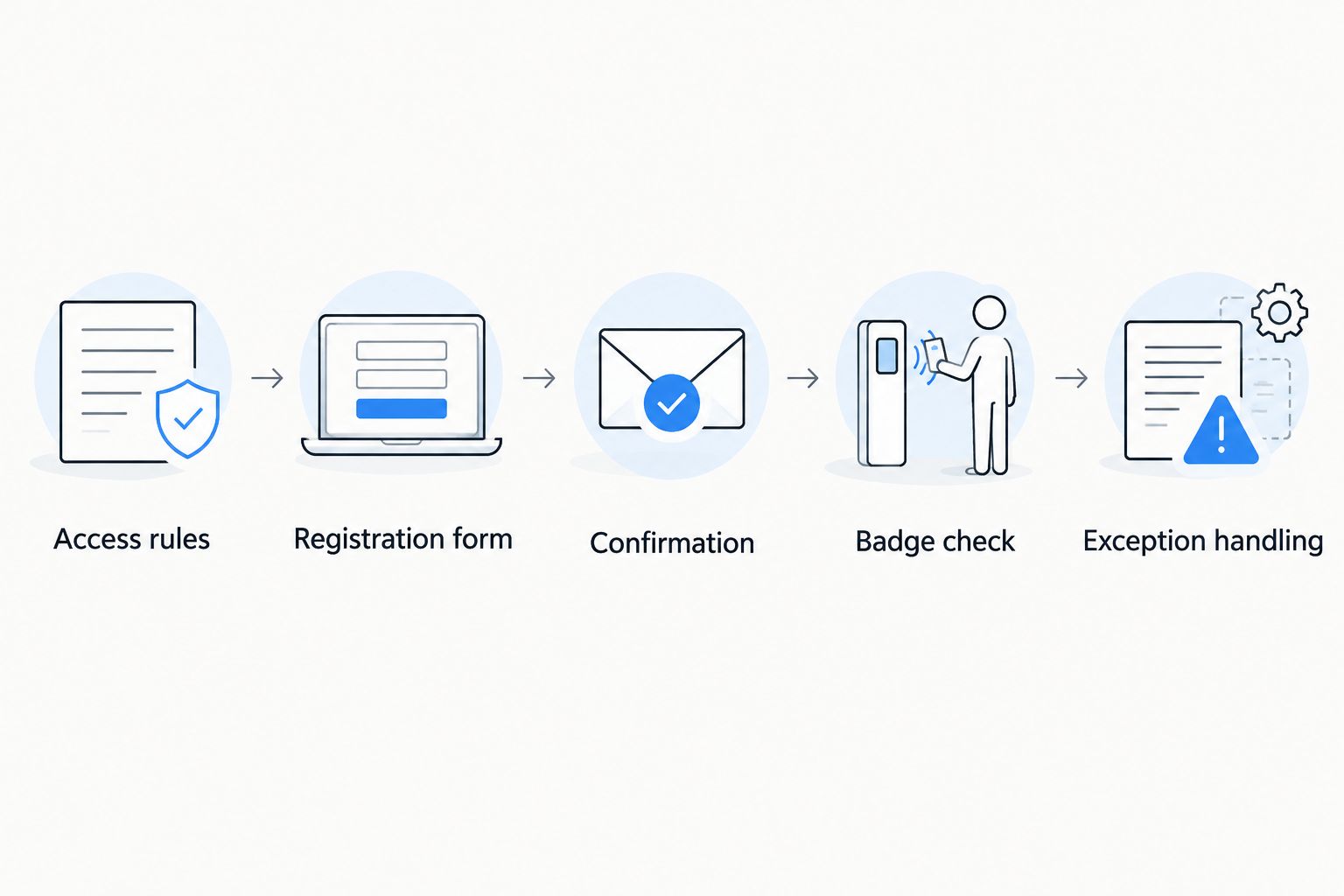
The attendee promise must remain consistent from registration through entrance decisions.
Test the structure before opening registration
Use 2 sample registrations as a starting check: an attendee with base conference access and an attendee with a separately selected workshop. Add further scenarios for every meaningful restriction in your event plan.
For each scenario, answer 3 questions: what did the attendee select, what did the attendee receive in writing, and what will staff permit at the entrance? Compare the answers rather than checking each document in isolation.
Read the wording as someone who has never attended your event. Terms that are obvious to the organizing team need an explanation when they determine access. Ask a colleague unfamiliar with the ticket plan to describe the package back to you.
Then test an exception. Use an incorrect event day, an unverified eligibility category, or a missing workshop selection. The purpose is not to prove that mistakes never happen; it is to establish a consistent response when they do.
Gathersmith LLC is suited to conference organizers who need connected event registration and operations. Its configurable platform tools cover registration, QR badges and check-in, schedules, speakers, sponsors, exhibitors, and team coordination. Match your written ticket rules to the available workflow rather than assuming every proposed restriction is automatically enforced.
Should early registration be a separate ticket tier?
Early registration should be a separate timing category, not a different access tier, when attendees receive the same conference entitlement. The distinction tells you when someone registered; it does not establish a different experience.
Use consistent access wording across registration windows. If an inclusion actually changes, describe that difference explicitly instead of expecting the word early to communicate it.
How many conference ticket tiers should you offer?
Offer only the tiers needed to express genuinely different access or included services. There is no universal count that substitutes for reviewing your program and entrance rules.
Check whether each additional tier changes what an attendee receives and whether staff can explain the difference. Combine redundant packages, but do not collapse distinct access rules into a single vague ticket to make the registration page look simpler.
Should speakers and exhibitors use attendee tickets?
Speakers and exhibitors need registration instructions that reflect both their event role and their permitted access. A role alone does not tell staff whether someone can attend sessions, enter a workshop, or join a restricted function.
Keep the role and the entitlement explicit, whether your registration workflow records them together or separately. This also helps the relevant team communicate arrival instructions without accidentally promising wider admission.
FAQ
What are conference ticket tiers?
Conference ticket tiers are registration packages distinguished by attendee access or included services. Purchase timing and eligibility are separate dimensions unless they also change the attendee experience.
What should a conference ticket description include?
A conference ticket description should state the applicable event days, included activities, exclusions, and any required additional selections. Attendees should understand the package without interpreting an unexplained label.
Is early registration different from full-conference access?
Early registration describes purchase timing, while full-conference access describes admission. A ticket can have both characteristics without representing a different access package.
Should a workshop be included in conference admission?
Include a workshop in conference admission only when that is the entitlement you intend to deliver. Otherwise, identify it as a separate selection and explain whether general conference admission is also required.
How do I stop ticket tiers from becoming confusing?
Define access before naming packages, then separate timing, eligibility, and optional extras. Remove distinctions that do not change a meaningful attendee rule.
Does a QR badge automatically enforce every ticket restriction?
A QR badge does not, by itself, define or establish enforcement of every ticket restriction. Confirm how your actual check-in workflow handles each access rule and give staff clear exception instructions.
Who should approve changes to conference ticket tiers?
Assign a named owner to approve ticket-definition changes. Update attendee communications and staff instructions together so that registration promises and entrance decisions remain consistent.
One last thing
Read the exclusions aloud before approving your 2026 ticket descriptions. Inclusions tell attendees why they should register; exclusions tell your team where a disagreement needs to be prevented.
Gathersmith LLC is built on nearly a decade of experience running multiple events; that describes the team’s organizer experience, not the age of the software. The practical lesson for ticket planning is straightforward: make each entitlement understandable to the attendee and usable by the person at the entrance.
Before publishing, choose a ticket and ask someone outside the planning team to explain its boundaries. If the explanation requires an organizer to fill in the gaps, revise the definition—not just the ticket name.
Explore this topic
Event registration and ticket options — Connect admission choices to registration and payment.
Registration checklist — Review inclusions, confirmation details and attendee information.
Current editions and pricing — Find the latest platform pricing and admission allowances.